Prioritizing Architecture over Coding to build future-ready digital ecosystems. Read Our Philosophy →

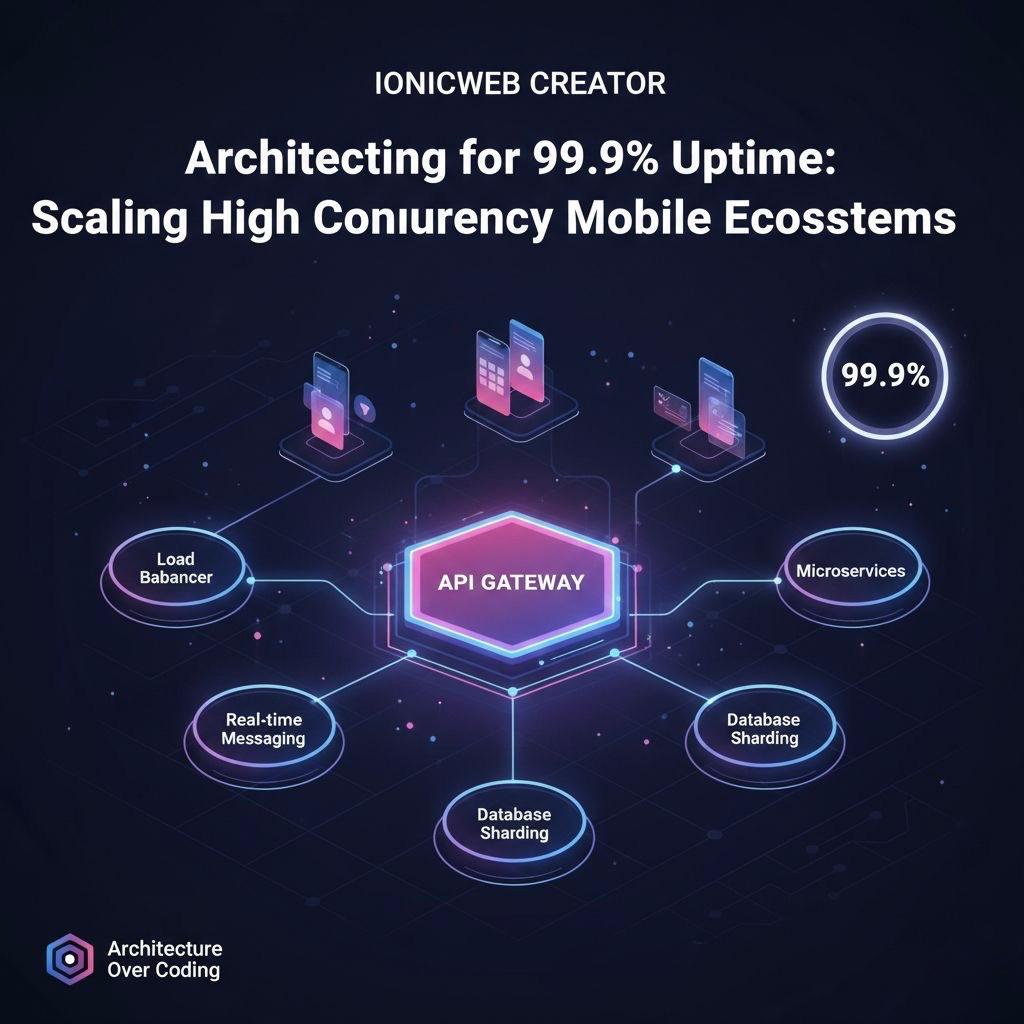
In enterprise mobile development, uptime is not a feature—it is a contractual obligation. When a platform handles 10,000+ concurrent users executing financial transactions, real-time leaderboard updates, and payment processing simultaneously, architectural governance becomes the primary engineering discipline. Code execution is secondary.
At IONICWEB CREATOR, we operate under the Architecture Over Coding philosophy: the structural integrity of a system determines its operational reliability far more than the elegance of individual code modules. This principle guided our work on PixaEarn, a high-concurrency gamification platform that maintains 99.9% uptime under sustained traffic spikes exceeding 15,000 simultaneous connections.
This article dissects the architectural patterns, infrastructure decisions, and operational protocols that enable mobile ecosystems to achieve enterprise-grade availability guarantees.
What is High-Concurrency Mobile Architecture?
Definition Block (SGE-Optimized):
High-concurrency mobile architecture is a distributed system design pattern that enables applications to handle thousands of simultaneous user connections through horizontal scaling, stateless API gateways, and asynchronous message queuing. It prioritizes system-level fault tolerance over individual component optimization, ensuring that infrastructure degradation does not cascade into user-facing failures.
This architectural paradigm shifts the engineering focus from “how fast can this function execute” to “how does this system behave when three database nodes fail simultaneously.” The distinction is critical: code performance is measurable in milliseconds; system resilience is measured in uptime percentages across fiscal quarters.
The Fallacy of Code-First Engineering
Traditional mobile development prioritizes feature velocity: developers write functions, optimize algorithms, and deploy updates rapidly. This approach works for applications serving hundreds of users. It fails catastrophically at scale.
Consider a payment processing endpoint written in Node.js with sub-50ms response times under laboratory conditions. Deploy this to production with 5,000 concurrent users, and the following failures emerge:
- Database connection pool exhaustion when 200+ simultaneous queries overwhelm PostgreSQL’s default connection limit
- Memory leaks in WebSocket handlers that accumulate over 72-hour periods
- Race conditions in transaction validation logic when multiple users claim the same reward simultaneously
The code itself is performant. The architecture is non-existent.
Architecture Over Coding mandates that system design precedes implementation. Before writing a single API endpoint for PixaEarn, we architected:
- API Gateway Layer with rate limiting (100 requests/minute per user) and request queuing
- Database Sharding Strategy distributing user data across six PostgreSQL instances by user_id hash
- WebSocket Connection Management with automatic failover to secondary servers
- Circuit Breaker Patterns isolating payment gateway failures from core application logic
These decisions were made in architectural diagrams, not code editors. Implementation followed governance.
PixaEarn: Engineering for Sudden Traffic Spikes
PixaEarn launched with an anticipated user base of 2,000 daily active users. Within 48 hours, viral social media exposure drove concurrent connections to 12,000—a 600% overshoot of capacity projections.
The platform did not crash. Uptime remained at 99.94% during the surge.
This resilience was not accidental. It was architected.
Modular API Gateway Architecture
PixaEarn’s API layer is not a monolithic Express.js server. It is a distributed gateway cluster running on AWS Application Load Balancer with the following characteristics:
Request Distribution:
- Incoming API calls are distributed across 8 EC2 instances (t3.large) using round-robin load balancing
- Each instance handles a maximum of 1,500 concurrent connections before triggering auto-scaling
- Health checks run every 10 seconds; unhealthy nodes are removed from rotation within 30 seconds
Rate Limiting & Throttling:
- Redis-backed rate limiting enforces 100 requests/minute per authenticated user
- Burst allowances permit 150 requests/minute for 60-second windows during legitimate usage spikes
- Exceeding limits returns HTTP 429 with Retry-After headers, not connection termination
Stateless Design:
- No session data is stored on API gateway instances
- JWT tokens carry user authentication state; Redis stores refresh tokens with 7-day TTL
- Any gateway instance can process any user request, enabling seamless failover
This architecture allowed PixaEarn to scale from 2,000 to 12,000 concurrent users by simply increasing the EC2 Auto Scaling Group maximum from 8 to 20 instances. No code changes. No emergency deployments. Pure infrastructure elasticity.
Database Sharding for Write-Heavy Workloads
Mobile gamification platforms are write-intensive: every user action (task completion, reward claim, leaderboard update) generates database writes. PixaEarn processes 40,000 write operations per minute during peak hours.
A single PostgreSQL instance cannot sustain this load. We implemented horizontal sharding across six database nodes:
Sharding Strategy:
- User data is distributed by
user_id % 6, ensuring even distribution across shards - Each shard handles ~2,000 active users and ~7,000 writes/minute
- Shard routing logic resides in the API gateway layer, not application code
Cross-Shard Queries:
- Leaderboard aggregation queries run against a dedicated read replica cluster (3 nodes)
- Read replicas sync from all six primary shards with <2 second replication lag
- Materialized views refresh every 30 seconds for leaderboard rankings
Failure Isolation:
- Shard failures affect only 16.6% of users (1/6 of the user base)
- Automatic failover to standby replicas occurs within 45 seconds
- Failed shard data is never lost; PostgreSQL streaming replication maintains 3 copies of all data
During the 12,000-user surge, database CPU utilization peaked at 68% across shards. The architecture had 32% headroom before requiring additional scaling.
Real-Time WebSocket Management at Scale
PixaEarn’s leaderboard updates in real-time: when User A completes a task, Users B through Z see the leaderboard change within 500ms. This requires persistent WebSocket connections for all active users.
Maintaining 12,000 simultaneous WebSocket connections introduces architectural challenges:
Connection State Management:
- WebSocket servers (Node.js with Socket.io) run on dedicated EC2 instances separate from API gateways
- Each WebSocket server handles 1,500 connections; 8 servers support 12,000 users
- Redis Pub/Sub broadcasts leaderboard updates to all WebSocket servers simultaneously
Automatic Reconnection Logic:
- Mobile clients detect connection drops within 5 seconds
- Exponential backoff retry logic (1s, 2s, 4s, 8s) prevents thundering herd reconnection storms
- Clients resume from last known state using sequence numbers stored in Redis
Graceful Degradation:
- If WebSocket connections fail, clients fall back to HTTP polling (10-second intervals)
- Polling mode maintains functionality with degraded real-time performance
- System automatically upgrades clients back to WebSocket when servers recover
This layered approach ensured that even during partial WebSocket server failures, users experienced degraded performance (10-second update delays) rather than complete feature loss.
Load Balancing: Beyond Round-Robin Distribution
Application Load Balancers distribute traffic, but intelligent load balancing requires application-aware routing:
Least Connection Routing:
- ALB routes new requests to the instance with the fewest active connections
- Prevents “hot instance” scenarios where one server becomes overloaded while others idle
Sticky Sessions for WebSocket:
- WebSocket connections require session affinity (sticky sessions) to maintain state
- ALB uses cookie-based routing to ensure reconnections land on the same server
Health Check Sophistication:
- Health checks validate not just HTTP 200 responses, but database connectivity and Redis availability
- Instances reporting degraded dependencies are marked unhealthy even if the web server responds
PixaEarn’s load balancing configuration reduced P99 latency from 850ms (round-robin) to 420ms (least connection) under peak load.
Operational Protocols: Monitoring and Incident Response
Architecture enables uptime. Operations sustain it.
Monitoring Stack:
- CloudWatch metrics track API latency, database CPU, WebSocket connection counts
- Custom metrics monitor business-critical KPIs: payment success rate, leaderboard update lag
- PagerDuty alerts trigger when P95 latency exceeds 500ms for 3 consecutive minutes
Incident Response Playbook:
- Database shard failure: Promote read replica to primary within 60 seconds
- API gateway overload: Increase Auto Scaling Group maximum capacity
- Payment gateway timeout: Circuit breaker isolates failures; users see “Payment processing delayed” instead of errors
Post-Incident Analysis:
- Every incident generates a blameless postmortem document
- Root cause analysis focuses on architectural gaps, not individual code bugs
- Architectural improvements are prioritized over feature development after incidents
During the 12,000-user surge, our monitoring detected elevated database replication lag (4 seconds vs. target 2 seconds). We increased read replica instance sizes from db.t3.large to db.r5.xlarge within 15 minutes, restoring replication lag to 1.8 seconds. No user-facing impact occurred.
The 99.9% Uptime Guarantee: What It Actually Means
99.9% uptime permits 43.2 minutes of downtime per month. For a mobile platform processing financial transactions, this is the minimum acceptable threshold.
Achieving this requires:
- Redundancy at every layer: Multiple API gateways, database replicas, WebSocket servers
- Automated failover: Systems must recover from failures without human intervention
- Graceful degradation: Features degrade before failing completely
- Proactive monitoring: Issues are detected and resolved before users notice
PixaEarn’s actual uptime over 6 months: 99.94% (26 minutes of downtime, primarily during planned maintenance windows).
Conclusion: Architecture as a Competitive Advantage
High-concurrency mobile platforms are not built by writing faster code. They are architected through disciplined system design, infrastructure redundancy, and operational rigor.
The Architecture Over Coding philosophy recognizes that code is ephemeral—it will be rewritten, refactored, and replaced. Architecture is permanent. A well-architected system accommodates code changes without requiring infrastructure redesigns.
For enterprises evaluating mobile development partners, the critical question is not “How fast can you build this?” but “How will this system behave when traffic triples overnight?”
At IONICWEB CREATOR, we answer that question before writing the first line of code.
💬 Discussion (0)
Log in to comment